This weekend I did a little home redecorating in my study. I have thousands and thousands of family photos from my years of doing research - all carefully scanned and archived on my computer, the originals carefully tucked away in boxes.
What good does that do!?
This wall is a collection of photos, documents, and artwork showing nearly every branch of my family. There's a mix of sizes, centuries, formal and candid images. Sometimes it's those candid shots - when spontaneous moments are captured on film - that are my favorites.
Monday, November 11, 2013
Saturday, November 2, 2013
Henry hits the seas
Today I came one step closer to figuring out how, when, and where Henry Staker immigrated to the US.
Previously, I thought he came in September 1870 on the steamship Italy. His obituary and Census records always claimed he came in 1869, but since I couldn't find anything in that year I made the (incorrect) assumption that 1870 was the actual date.
This week when I uncovered Henry's passport application from 1910, I found he claimed to immigrate "on or about" Dec. 2, 1869. The application didn't specify if that was the date of departure or arrival. Under the steamship name he wrote "don't know". Super.
So, it was back to the drawing board. This morning I undertook the tedious effort of going through German passenger lists, combing through records in the hopes of finding something close to Henry Staker in the rolls. I searched Henry, Henrich, Heinr, and Staker, Stacker, Stecker, and everything in between. After about an hour, I found a promising hit on Heinrich Stäcker.
Heinrich Stäcker was listed as 24 in 1869, which is a few years older than Henry Staker, but not an automatic rule-out. I've seen ages on documents vary 3-5 years depending on the record. I also know from Henry's naturalization paper that in 1883 he still spelled his name Stäker.
The next big clue was his home: Bramstedt. In Henry's obituary it says he was born in Harmstedt, Holstein. To date, I have no been able to find a Harmstedt. I have found in researching other German ancestors like Henry Sienknecht and Henry Kuhse that families often approximated the names of hometowns according to what they could remember. Freida (Krambeck) Sienknecht's home town of Lindhöft was spelled Linahoft, Linden, Lindenhof and Linahof depending on the record. A quick Google of Bramstedt came up with Bad Bramstedt in Schleswig-Holstein.
Heinrich Stäcker was also listed as a farmhand, which also makes sense, as he came to Iowa to become a farmer.
The only problem is there's no corresponding passenger list for the steamship Roland in New York in November or December 1869. The Hamburg departure list says the ship was destined for New York via Liverpool. Did the ship never make it? A search or records shows the Roland was still crossing the Atlantic into the 1890s, so it didn't go out of commission. Heinrich Stäcker doesn't appear on any New York passenger lists in 1869 - at least not that I've found yet.
I still have to go through the 5,000 records for the Roland that come up in an Ancestry search, but there is another possibility...
My father once told me that his grandfather (Henry's eldest son) used to say his father came to the US as a stowaway. The passenger list for the Roland leaving Hamburg was short, only a scant dozen names. Heinrich isn't listed as traveling first class, second class, or steerage on the Roland. In fact, it isn't specified. Is there something below steerage? Did he somehow finagle a ticket just sitting on deck or working his way to Liverpool? Once in England, did his ride on the Roland end? Did he find a way to the US on another ship, perhaps illegally hiding aboard another steamship? Since the Roland left Hamburg on Nov. 5, 1869, you would expect it to arrive in New York within two weeks. If Henry didn't arrive until Dec.2 as he specified on his passport, perhaps his trip was delayed by lack of funds, or lack of a legal ticket across the water.
There are still a lot of questions, some that may never have answers. But I feel like I'm getting closer, especially with the knowledge that Henry was almost certainly from Bad Bramstedt instead of Harmstedt. I have wanted to find a way to do research in Germany for a long time, but was not certain where to start. Now, I'm ready for the next step.
Previously, I thought he came in September 1870 on the steamship Italy. His obituary and Census records always claimed he came in 1869, but since I couldn't find anything in that year I made the (incorrect) assumption that 1870 was the actual date.
This week when I uncovered Henry's passport application from 1910, I found he claimed to immigrate "on or about" Dec. 2, 1869. The application didn't specify if that was the date of departure or arrival. Under the steamship name he wrote "don't know". Super.
So, it was back to the drawing board. This morning I undertook the tedious effort of going through German passenger lists, combing through records in the hopes of finding something close to Henry Staker in the rolls. I searched Henry, Henrich, Heinr, and Staker, Stacker, Stecker, and everything in between. After about an hour, I found a promising hit on Heinrich Stäcker.
Heinrich Stäcker was listed as 24 in 1869, which is a few years older than Henry Staker, but not an automatic rule-out. I've seen ages on documents vary 3-5 years depending on the record. I also know from Henry's naturalization paper that in 1883 he still spelled his name Stäker.
The next big clue was his home: Bramstedt. In Henry's obituary it says he was born in Harmstedt, Holstein. To date, I have no been able to find a Harmstedt. I have found in researching other German ancestors like Henry Sienknecht and Henry Kuhse that families often approximated the names of hometowns according to what they could remember. Freida (Krambeck) Sienknecht's home town of Lindhöft was spelled Linahoft, Linden, Lindenhof and Linahof depending on the record. A quick Google of Bramstedt came up with Bad Bramstedt in Schleswig-Holstein.
Heinrich Stäcker was also listed as a farmhand, which also makes sense, as he came to Iowa to become a farmer.
The only problem is there's no corresponding passenger list for the steamship Roland in New York in November or December 1869. The Hamburg departure list says the ship was destined for New York via Liverpool. Did the ship never make it? A search or records shows the Roland was still crossing the Atlantic into the 1890s, so it didn't go out of commission. Heinrich Stäcker doesn't appear on any New York passenger lists in 1869 - at least not that I've found yet.
I still have to go through the 5,000 records for the Roland that come up in an Ancestry search, but there is another possibility...
My father once told me that his grandfather (Henry's eldest son) used to say his father came to the US as a stowaway. The passenger list for the Roland leaving Hamburg was short, only a scant dozen names. Heinrich isn't listed as traveling first class, second class, or steerage on the Roland. In fact, it isn't specified. Is there something below steerage? Did he somehow finagle a ticket just sitting on deck or working his way to Liverpool? Once in England, did his ride on the Roland end? Did he find a way to the US on another ship, perhaps illegally hiding aboard another steamship? Since the Roland left Hamburg on Nov. 5, 1869, you would expect it to arrive in New York within two weeks. If Henry didn't arrive until Dec.2 as he specified on his passport, perhaps his trip was delayed by lack of funds, or lack of a legal ticket across the water.
There are still a lot of questions, some that may never have answers. But I feel like I'm getting closer, especially with the knowledge that Henry was almost certainly from Bad Bramstedt instead of Harmstedt. I have wanted to find a way to do research in Germany for a long time, but was not certain where to start. Now, I'm ready for the next step.
Thursday, October 31, 2013
The Daker File
Just last night I wrote about the mysteries surrounding my great-great grandfather, Henry Staker, and his family in his native Germany. As happens so often when writing on this blog, chronicling my experiences on a topic gives immediately piques my interests in something that may have been on the back burner for months or abandoned due to frustration.
This time it was travel records. As I wrote last night, I recently discovered Henry traveled back to Germany in the summer of 1910. I still don't know who he saw or what he did during that time, but I hope to figure that out along the way.
I also wrote about how difficult it can be to find information on his roots because of the various ways I find Staker spelled (and misspelled) in documents.
Last night, after hitting "publish" I went back to Ancestry and decided to do more digging into immigration and travel. I was specifically looking at Mr. and Mrs. Chris Hoeppner, the couple listed in the newspaper clipping as traveling companions for Henry. Searching for them, I found ship manifests showing their return from Germany around the same time, though on a different ship. I also found Mr. Hoeppner's passport application from April 1910.
Then, it hit me: Shouldn't Henry have a passport as well? In the many times I've searched "Henry Staker" in Ancestry there has never been a passport application come up in the results. But if someone traveling with him from the same area at the same time had a passport, shouldn't he?
This is where the name issue comes into play. First, I searched for "Staker" and then "Stacker" without results. When names don't work, I try other things. It can be tedious, but in this case it worked out. I searched for passport applications for people from Reinbeck, Iowa. No Henry. Then, I searched for applications from Traer, Iowa. Again, no Henry Staker.
But there was a Henry Daker.
I decided to give it a shot. I hoped the item and instantly knew it was him. Henry Daker, address Traer, Iowa, was born May 17, 1848, in Holstein, Iowa, just like Henry Staker. The application was filed April 15, 1910, shortly before Henry Staker headed to Germany.
What made it official was opening the scan of the original file. It was clear to me the application said Henry STAKER. The problem wasn't in how the officials spelled his name - it was how it was transcribed for Ancestry! The script of the capital "S" and lowercase "t" blended together enough that someone mistook the two letters for one, rendering the last name Daker and the application hidden to all my previous queries. I wonder how many other gems are hidden out there because of this issue!?
Now that I have the passport application, I have another mystery. The application has great information, including the date when the applicant entered the country if they're an immigrant. Henry always wrote that he arrived in 1869, but several years ago I thought I found him in passenger lists in September 1870. I chalked it up to Henry estimating or Census takers misquoting. But here, on his passport application, Henry was specific about the date he came to the U.S.: Dec. 2, 1869. Naturally, the application says "on or about" Dec. 2, 1869, but it seems like too specific of a date for a guess. Now, it's time to find out what ship (application says "don't know"), what port, and if Dec. 2, is his arrival in the U.S. or departure from Germany.
More answers mean more questions!
This time it was travel records. As I wrote last night, I recently discovered Henry traveled back to Germany in the summer of 1910. I still don't know who he saw or what he did during that time, but I hope to figure that out along the way.
I also wrote about how difficult it can be to find information on his roots because of the various ways I find Staker spelled (and misspelled) in documents.
Last night, after hitting "publish" I went back to Ancestry and decided to do more digging into immigration and travel. I was specifically looking at Mr. and Mrs. Chris Hoeppner, the couple listed in the newspaper clipping as traveling companions for Henry. Searching for them, I found ship manifests showing their return from Germany around the same time, though on a different ship. I also found Mr. Hoeppner's passport application from April 1910.
Then, it hit me: Shouldn't Henry have a passport as well? In the many times I've searched "Henry Staker" in Ancestry there has never been a passport application come up in the results. But if someone traveling with him from the same area at the same time had a passport, shouldn't he?
This is where the name issue comes into play. First, I searched for "Staker" and then "Stacker" without results. When names don't work, I try other things. It can be tedious, but in this case it worked out. I searched for passport applications for people from Reinbeck, Iowa. No Henry. Then, I searched for applications from Traer, Iowa. Again, no Henry Staker.
But there was a Henry Daker.
I decided to give it a shot. I hoped the item and instantly knew it was him. Henry Daker, address Traer, Iowa, was born May 17, 1848, in Holstein, Iowa, just like Henry Staker. The application was filed April 15, 1910, shortly before Henry Staker headed to Germany.
What made it official was opening the scan of the original file. It was clear to me the application said Henry STAKER. The problem wasn't in how the officials spelled his name - it was how it was transcribed for Ancestry! The script of the capital "S" and lowercase "t" blended together enough that someone mistook the two letters for one, rendering the last name Daker and the application hidden to all my previous queries. I wonder how many other gems are hidden out there because of this issue!?
Now that I have the passport application, I have another mystery. The application has great information, including the date when the applicant entered the country if they're an immigrant. Henry always wrote that he arrived in 1869, but several years ago I thought I found him in passenger lists in September 1870. I chalked it up to Henry estimating or Census takers misquoting. But here, on his passport application, Henry was specific about the date he came to the U.S.: Dec. 2, 1869. Naturally, the application says "on or about" Dec. 2, 1869, but it seems like too specific of a date for a guess. Now, it's time to find out what ship (application says "don't know"), what port, and if Dec. 2, is his arrival in the U.S. or departure from Germany.
More answers mean more questions!
Wednesday, October 30, 2013
Henry goes home
![]() |
| Henry & Minnie (Boldt) Staker |
Once you start researching you start to collect a lengthy list of surnames, especially when you get five, six, or seven generations back in your tree. These branches of my tree have roots all over Europe, with the majority located in Germany.
It was there, in 1848, that Henry Staker was born. Henry, my great-great grandfather, was the patriarch of the Staker family in Iowa. He came to the U.S. on his one in 1870 (his obituary said 1869, but passenger lists showed it was a year later). Like many Iowa Germans he made his way to Davenport before - for reasons yet unknown - he came to Tama County.
In 1877 he married another German, Wilhelmina Boldt, a woman 10 years his junior who had also settled in Tama County. The couple farmed in Grant Township and raised a family of 12 children (plus two who died in infancy). Wilhelmina, or Minnie has she was known, passed away Dec. 29, 1929, in Gladbrook, Iowa. Three days later, on the morning of what was supposed to be Minnie's funeral, Henry passed away as well. At the time of their deaths the Stakers had 37 living grandchildren, and six great-grandchildren. As the years progressed the generations expanded, creating an expansive Staker family that is still well-represented in Tama County - myself included.
While the legacy of Henry's family his well known, his heritage remains a mystery. Minnie came to the U.S. as a child with her parents and three brothers, all of whom lived in Tama County. She had an uncle in Tama County, another in Davenport, and numerous cousins. Henry came to the U.S. alone. There were no other Stakers on any U.S. Census records who weren't his direct descendants. His only family was the one he had with Minnie.
Perhaps most frustrating has been the inability to find Henry before he arrived in the U.S. I haven't had the time or resources to actually do research in Germany, but searches of online databases have proven fruitless. There have been some clues along the way. The 1925 Iowa Census, which had respondents write their parents' names (including mother's maiden name), told me Henry's parents were Hans and Margaret (Siems) Staker.
Of course, anyone who conducts family history research knows how unreliable spelling is in Census records. In fact, spelling has always been an issue for the Stakers. On Henry's naturalization certificate his name is spelled Stäker. The pronunciation has always been contested too, though it's well established that the original German sounded more like Stacker instead of Staker, and early newspaper accounts of the family added the "c" to the name.
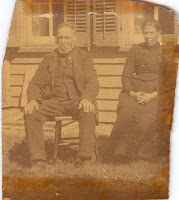
![]() |
| "Grandpa Staker's Folks" was the only information written on the back of this small, misshapen old image. |
But what happened to them? How long were they alive? When was the photo taken? I highly doubt Henry was an only child and the photo is clearly taken after Henry was in the U.S. Did they correspond? What were his connections to his homeland?
This summer, I found another clue. While combing through the archives at the Tama County Historical Society and studying The Tama Northern newspaper from Gladbrook, I came across this entry April 28, 1910.
Mr. and Mrs. Chris Hoeppner and Henry Stacker of Traer left Tuesday on an extended visit with relatives in Germany. They will be accompanied by Mr. and Mrs. John Hoeppner of Walcut, Iowa. The party expects to be in the Fatherland about three months.The first thing I did when discovering this was to research Mr. and Mrs. Chris Hoeppner. So far their connection to Henry other than being German has eluded me. For a time I started thinking this was a typo, that it wasn't Henry Staker, but some other Henry or a different last night. I once read a story stating the death of twin boys, both of whom I new when they were in their late 80s. Mistakes happened. Reporting was sloppy. Most of the time it was someone on the neighborhood just writing down gossip, third-hand details, and suppositions.
I put the details out of my mind for a while and went on to other things. Today, on a complete whim, I decided to log into Ancestry.com and search for Henry. I've done that many, many times, but every month or so I like to go back and re-search for someone. I always hope some distant cousin has suddenly posted a tree and tons of photos. (Actually did happen once, but that's another post).
This time what came up were ship manifests. They were the same ones that showed up every time I search for Henry, one being his immigration record from 1870 and others being nonstarters - or so I thought! This time, I looked with the newspaper clipping as context. If Henry left for Germany in April 1910 as the paper claimed, perhaps one of these records would show his arrival back home. The newspaper said he'd be gone nearly three months. Sure enough, among the German passenger lists was Henry Staker traveling from Hamburg back to the US, departing June 23, 1910.
But, was it him?
My answer to that is "Yes, I'm pretty sure." I say "pretty sure" because with family history it's hard to ever be really certain unless you have first-hand accounting or primary sources. There are enough factors in this record, however, to make me confident this is my Henry. First, the name (obviously). Next, the age: The passenger list says he was 63 (born in 1847), which is definitely close enough to 1848 to count (Old ship manifests had wide ranging ages for people, as did Census records. If a date is within a few years of the recorded birth year I consider it verified.).
The real clue came from what he listed as his residence and ethnicity.
Residence: ReinberkI believe Reinberk is a transcription error and should read Reinbeck, as in Reinbeck, Iowa, the Grundy County town near where Henry lived. His Grant Township farm was somewhere between Traer and Reinbeck, so Reinbeck could have been the post office from which he received mail. The fact he lists his nationality as "American" says to me this Henry and mine are one in the same.
Ethnicity/Nationality: USA (American)
A search of American port arrivals shows the ship arrived July 2, 1910, in New York, with Henry (now listed as 62) on board.
So, now that I've confirmed Henry traveled back to his homeland for the summer of 1910, the next question is deceptively simple: What was he doing there!?
That's a question still in want of an answer at this point. Without knowing more about his family in Germany, it's impossible to know who was living, who he visited, where he stayed, and what occurred during his few months abroad. I would like to think he visited relatives and told about his life in Iowa with a large family, many grandchildren, a prosperous farm, and general success. I wonder if his parents were still living. Was this when he brought back their small photo? Did he have aunts, uncles, sisters, brothers, cousins? Did they gather to see their American cousin come home after 40 years?
There are so many questions related to Henry's trip. I don't know if I'll ever find the answers. However, I'm confident - now that I know he did, in fact, travel to Germany as the newspaper said - that those answers do exist.
Somewhere.
Tuesday, October 22, 2013
Making connections
I started the blog in the hopes fellow family historians out there would find me, find shared surnames, see familiar faces in previously unidentified photos, and end up solving all of my problems.
Perhaps that last part is too lofty a goal, but for the rest, I'm happy to say it's working amazingly well!
I've connected with several distant Sabin cousins and through them have identified various photos. Most recently I heard from Derek Swezey, another descendent of Oliver and Maria (Swezey) Sabin, who helped identify two additional photos in Grandma Sabin's album. Both photos were actually photos of Rosa Swezey, Oliver and Maria's daughter and one of the few individuals who had an identified photo in my collection! Now that I've compared this photo with others, it's hard for me to know how I didn't see the similarities earlier. Sometimes when you're doing this for so long you almost become blind to the subtle clues that can lead to the answers.
Derek told me he would be sharing my blog with others in his family, so I hope they come here, read this, and can find the same success. I look forward to future connections!
The top photo was the one that had been identified by handwriting on the back as "Rosa Swezey, 1871". The bottom two were identified with the help of Derek Swezey comparing the identified photo to the other unmarked images.
Perhaps that last part is too lofty a goal, but for the rest, I'm happy to say it's working amazingly well!
I've connected with several distant Sabin cousins and through them have identified various photos. Most recently I heard from Derek Swezey, another descendent of Oliver and Maria (Swezey) Sabin, who helped identify two additional photos in Grandma Sabin's album. Both photos were actually photos of Rosa Swezey, Oliver and Maria's daughter and one of the few individuals who had an identified photo in my collection! Now that I've compared this photo with others, it's hard for me to know how I didn't see the similarities earlier. Sometimes when you're doing this for so long you almost become blind to the subtle clues that can lead to the answers.
Derek told me he would be sharing my blog with others in his family, so I hope they come here, read this, and can find the same success. I look forward to future connections!
![]() |
| Rosa Swezey |
![]() |
| Rosa Swezey |
![]() |
| Rosa Swezey |
We're live!
Tama County Historical Society & Genealogical Library has a website!
Check out www.tamacountyhistory.org to browse a list of collections, see photos of museum holdings, submit unidentified photos from Tama County past and learn about upcoming educational programs.
Tuesday, October 8, 2013
Historical Society website
I'm excited to say the Tama County Historical Society & Genealogical Library will be jumping into the 21st Century!
Last week the board approved creating a website for the museum and library, a task I have happily volunteered to orchestrate. Work has already begun on creating a site to inform visitors about the great things at the Historical Society, as well as the many ways they can become involved in research or volunteering. The hope it to no longer be "the best kept secret" in family history research and grow the membership base.
Look for the launch of www.tamacountyhistory.org in the next month.
Last week the board approved creating a website for the museum and library, a task I have happily volunteered to orchestrate. Work has already begun on creating a site to inform visitors about the great things at the Historical Society, as well as the many ways they can become involved in research or volunteering. The hope it to no longer be "the best kept secret" in family history research and grow the membership base.
Look for the launch of www.tamacountyhistory.org in the next month.
Subscribe to:
Posts (Atom)


